Using AI as Your Co-Pilot, Not Your Ghostwriter
Write your resume for impact
The best resumes in 2026 aren't written by AI. They're written with it — and they're still you. Still human.
There's a big difference. Hand the whole job to a chatbot and you'll get something polished, confident, and unmistakably machine-made. Recruiters can tell. They read hundreds of these a week, and the AI-written ones have a tell: smooth, generic, soulless. The moment a recruiter senses a resume wrote itself, you get passed on.
It's worse than that, actually. Recruiters are being lied to and burned — candidates letting AI invent experience they never had, then falling apart in the interview. That has made hiring teams suspicious of anything that smells automated. So the bar isn't just "use AI well." It's "make sure it still reads like a real person wrote it." Because a real person did.
Here's the workflow that gets you there.
Type it out yourself first
This is the part most people skip, and it's the whole game. Write your resume — or at least your raw bullets — in your own words first. Messy is fine. The point is that the substance, the truth of what you actually did, comes from you. AI can't know your career. It can only polish what you give it.
Then hand it to AI to sharpen
Once your real experience is on the page, that's when AI earns its seat. Ask it to make your draft clearer, more concise, more eloquent. Tighten the rambling bullet. Find the stronger verb. Trim the line that's doing too much. You're not asking it to write — you're asking it to edit. Same facts, better delivery.
Lead with impact, not duties
While you're at it, let AI help you turn responsibilities into results. Anyone can list duties; the resumes that land interviews quantify the win:
Before: "Responsible for quality inspections."
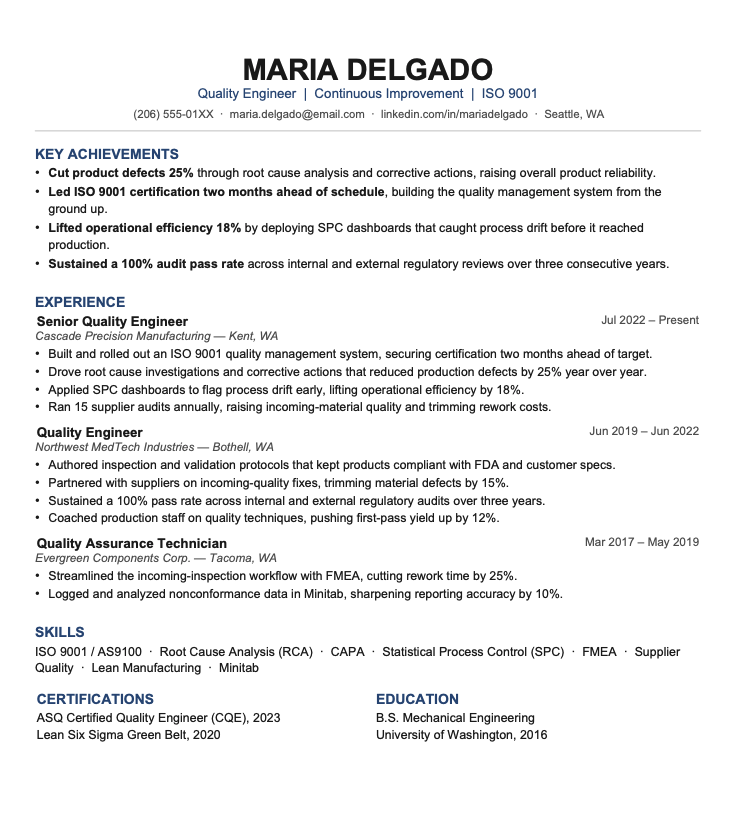
After: "Cut product defects 25% through root-cause analysis and corrective actions."
Same job. One of them gets a callback. Just keep every number true — defensible in an interview, every time.
Read it back in your own voice
Before you send it, read every line out loud. Does it sound like you? If a sentence feels stiff or too perfect, rewrite it in your own words. The goal is the clearest version of you — not a template wearing your name. That final human pass is what separates a resume that gets read from one that gets discarded.
The takeaway
AI is a brilliant co-pilot: it sharpens, tightens, and pushes you to prove your impact. But you write first, you keep it honest, and you keep your voice. Type it out, hand it over, take it back, and make it sound human again — because the candidate who shows up to the interview has to be the same person the resume promised.
Example Prompt to use with Claude AI
“You are an expert technical recruiter who hires Quality Engineers. I'm going to give you (1) a resume format to follow, (2) my current resume, and (3) a target job description.
Rewrite my resume by doing all of the following:
Follow this exact format/structure: [PASTE THE FORMAT — e.g. header → summary → skills → experience → education/certs, reverse-chronological].
Match the job description below. Pull the key skills, tools, methodologies, and phrasing from it and mirror that wording where it truthfully applies to my experience: [PASTE FULL JOB DESCRIPTION].
Research the company's culture for [COMPANY NAME] and weave in a few of the same descriptive/value words they use (e.g. how they talk about quality, customers, collaboration), but only where it's accurate to me.
Do not lie, invent, inflate, or embellish anything. Use only the experience, skills, and metrics in my resume. If something would strengthen the resume but isn't in my background, ask me about it instead of fabricating it.
Keep it to 2 pages, succinct, single-column, with bullets that lead with quantified impact.
Do not reuse the same phrasing across job positions — every role should have distinct verbs and varied wording so nothing reads as copy-pasted.
Where you've added a job-description keyword, briefly note it so I can confirm it's truthful.
Here is my current resume: [PASTE RESUME].”